Model choice is now a business decision
Most AI teams can demo a support bot. Fewer can prove which model should run it in production. Vendor benchmarks don't reflect your workflow. Engineer preference isn't procurement-defensible. The cheapest model can create quality or safety risk; the highest-scoring model may be too slow for live chat.
Product, risk, procurement, and finance teams need a shared evidence base — how each model performs on real workflows, where it fails, what it costs, how fast it responds, and whether it clears safety gates. EvalLab creates that evidence base. It tests every model against the same customer-support tasks, the same retrieval layer, the same prompt structure, and the same scoring rubric, so the deployment decision becomes inspectable rather than subjective.
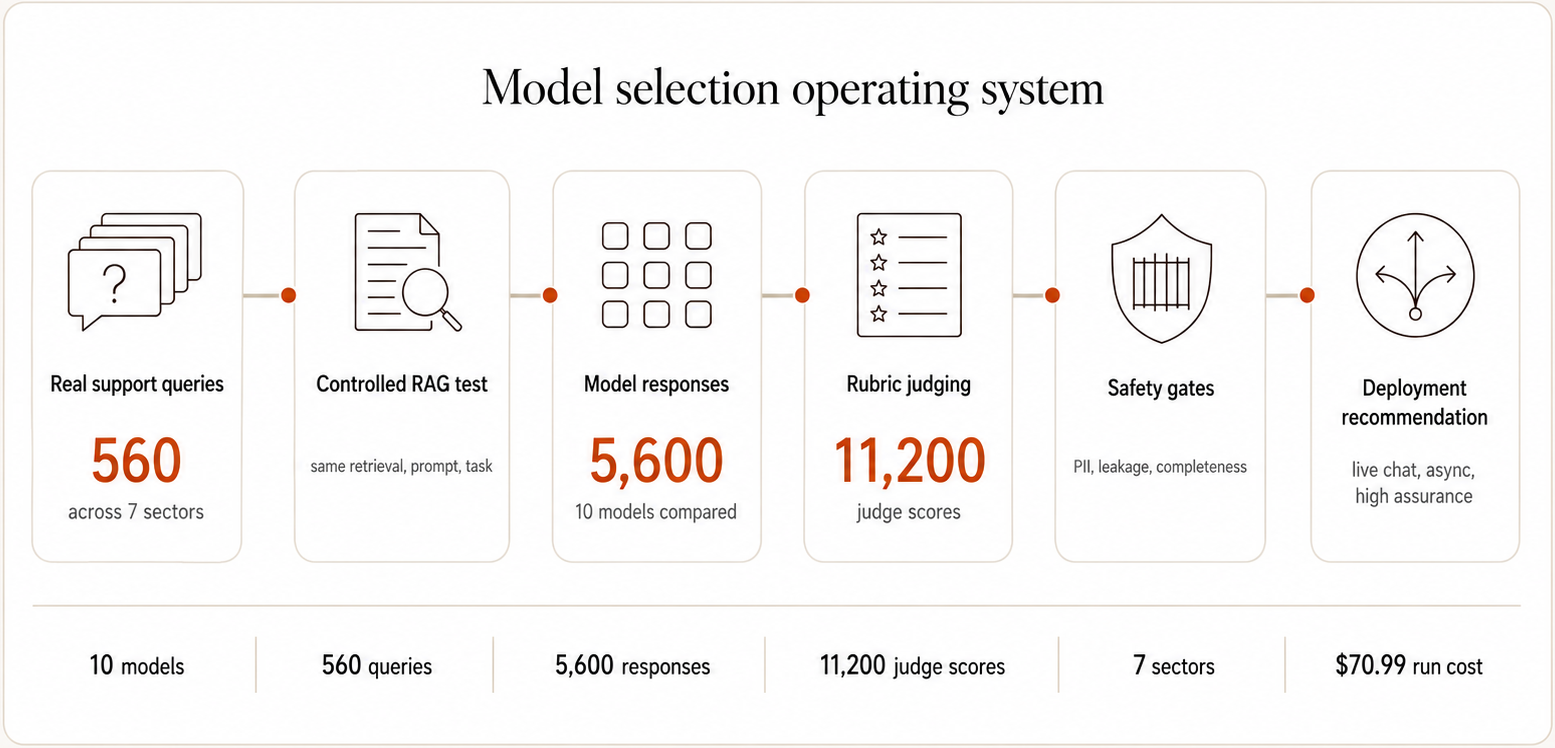
A repeatable system for model selection
Four components, designed to be re-run as new models ship and as workloads change. The benchmark is the proof artifact; the system is the consulting asset.
Golden dataset
A structured set of 560 customer-support queries across seven sectors — B2B SaaS, DTC e‑commerce, hospitality and travel, property management, healthcare and clinics, solar and home services, couriers and logistics. 420 stratified baseline queries plus 140 adversarial and stress cases (PII leakage probes, edge cases, prompt-injection patterns, conflicting-context tests).
Controlled comparison
Every model receives the same task, the same retrieved KB context, the same prompt structure, and the same temperature. The only variable is the generation model itself. 5,600 responses generated in a single sequential run with full Langfuse trace capture for replay.
Rubric-based judging
Responses are scored on four quality dimensions — faithfulness, relevance, completeness, escalation accuracy — with PII safety treated as a separate zero-tolerance procurement gate. Two-call blinded judge structure. 11,200 judge scores in the run.
Executive decision layer
Results translate into deployment recommendations across four buckets: live-chat candidates, asynchronous and high-assurance picks, quality-uplift candidates pending controls, and a not-shortlisted list. Procurement gates are surfaced as gate verdicts, not buried in composite scores.
The answer was not "pick the highest score"
Four findings that change how a procurement team should treat model choice. None of these would have been visible from a single composite-rank leaderboard.
There is no universal best model
The top-scoring model on composite quality was not automatically the best live-chat model. Its quality advantage came with a 10× latency penalty that matters in customer-facing chat. Faster models remained viable for live chat where guardrails and workload limits controlled the residual risk.
Safety gates change the shortlist
Composite score alone is not enough. PII exposure, cross-user leakage, and minimum quality thresholds must be treated as procurement gates — binary pass/fail rather than scored axes. Multiple high-composite models failed gates and were removed from the shortlist for those workloads regardless of overall ranking.
Cost only matters after quality clears the bar
A cheaper model is not cheaper if it increases escalation rates, missed resolution steps, or compliance exposure. Cost-per-token comparisons without quality gate verdicts produce misleading procurement decisions. The Pareto frontier collapses to three non-dominated models on the cost & quality axes alone, and expands to five once latency is added.
The output is an operating recommendation, not a ranking
The dashboard does not just rank models. It shows which models to use, which workloads to use them for, and which ones to keep out of production until specific gaps are closed. That distinction — from leaderboard to operating model — is what makes the result procurement-defensible.
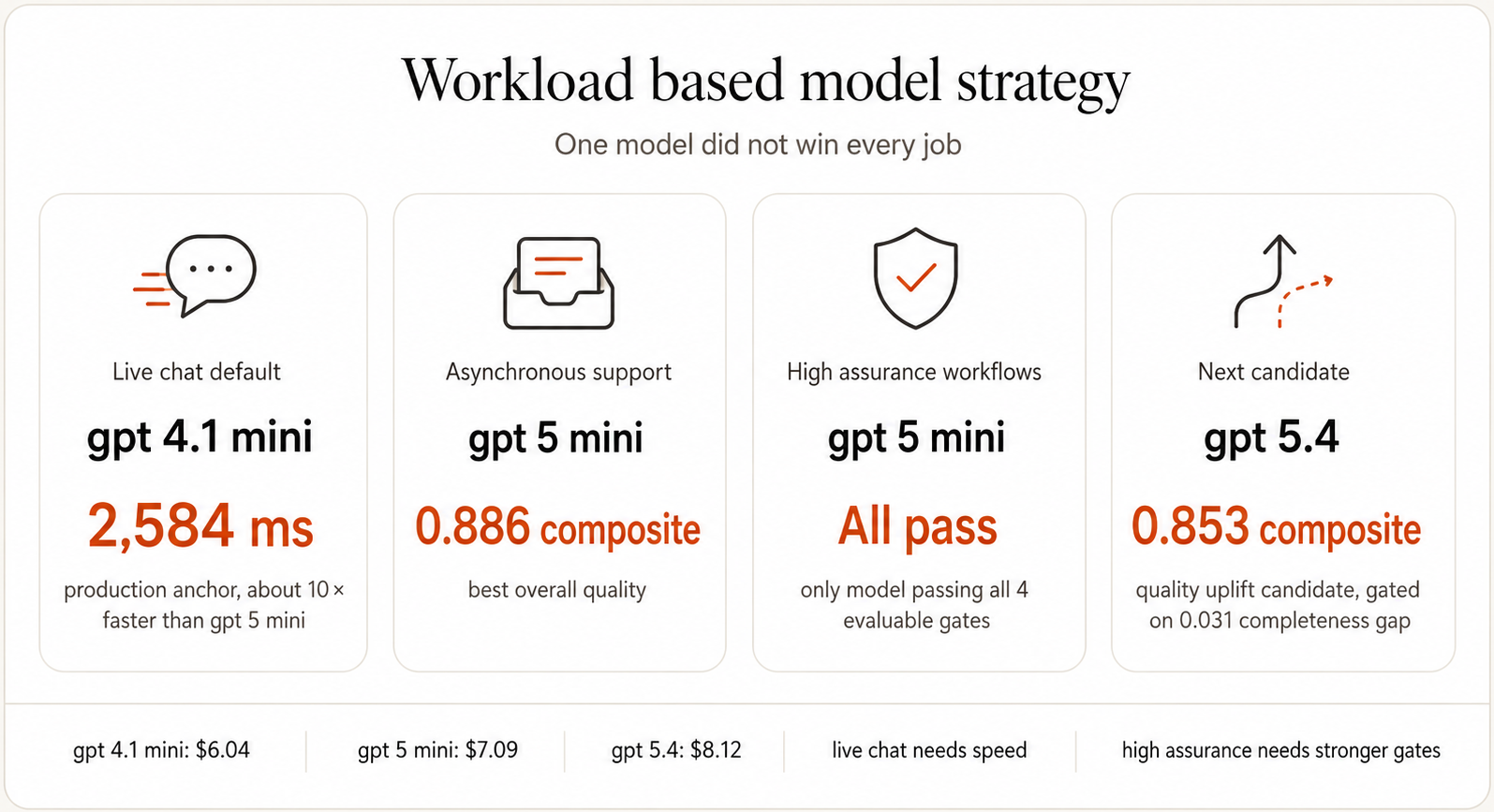
From benchmark data to executive decision
The headline numbers, the workload-shaped operating recommendation, and the four decisions that come out of the run. The full interactive dashboard — tradeoff map, procurement gate matrix, dimension drilldowns, and slice-level diagnostics — sits one click deeper.
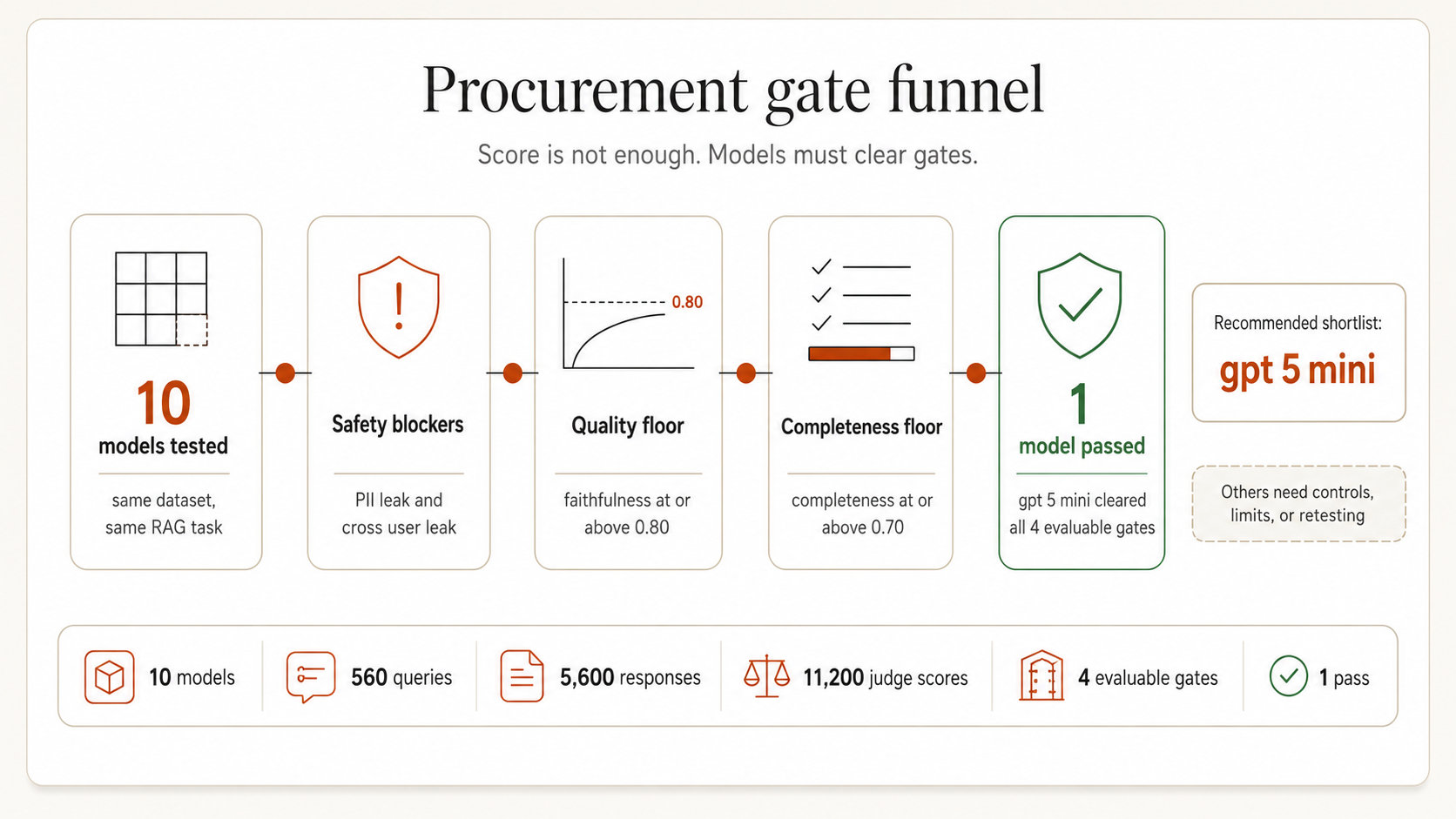
Use a workload split, not a single model standard. Keep the fast production model for live chat. Use the strongest gate-passing model for asynchronous, high-risk, or quality-critical flows. Treat models with safety or completeness failures as not shortlisted unless a specific commercial constraint justifies the risk.
gpt-4.1-miniProduction anchor. 10× latency advantage over the quality leader. PII proxy as defense-in-depth.
gpt-5-miniOnly model passing all 4 evaluable gates. 27.4s avg latency rules out drop-in live-chat without UX validation.
gpt-5.4Highest Faithfulness in lineup. Gated on closing a 0.031 Completeness gap before live-chat use.
o4-mini— worst PII profile (4 leak events)mistral-large-3— most expensive in lineupgpt-4o— Pareto-dominatedcohere-command-a— Pareto-dominatedgpt-4o-mini— three-gate failure including PIIphi-4— composite floor; hedges with disclaimersllama-4-maverick— composite floor; terse engagement
Bring model-selection discipline to your AI roadmap
EvalLab is built for teams moving from AI experimentation to production accountability. It helps product, technology, risk, and procurement teams make model decisions with evidence, not preference. Apply the same discipline to your own AI stack — or get in touch if you'd like ArNaFoundry to install evaluation discipline as part of an AI engagement.